

How Many Is 1 Dozen

A box of a dozen doughnuts
A dozen (commonly abbreviated doz or dz) is a grouping of twelve.
The dozen may exist ane of the primeval archaic integer groupings, possibly considering at that place are approximately a dozen cycles of the Moon, or months, in a cycle of the Dominicus, or year. Twelve is convenient because information technology has a maximal number of divisors amongst the numbers up to its double, a property only true of 1, 2, vi, 12, threescore, 360, and 2520.[1]
The use of twelve every bit a base of operations number, known as the duodecimal organisation (also equally dozenal), originated in Mesopotamia (encounter also sexagesimal). Counting in base-12 can easily be achieved on one's hands by counting each finger bone with one'south thumb. Using this method, 1 hand can count to twelve, and two easily (with the second manus as a placeholder for representing units of twelve) tin can count to 144. Twelve dozen (122 = 144) are known as a gross; and twelve gross (123 = 1,728, the duodecimal 1,000) are called a nifty gross, a term almost often used when aircraft or buying items in bulk. A dandy hundred, also known as a small gross, is 120 or ten dozen.
A baker's dozen, besides known as a large or long dozen, is a grouping of 13. Varying by state, some products are packaged or sold by the dozen, frequently foodstuff (a dozen eggs). Dozen may as well be used to express a large quantity as in "several dozen" (eastward.g., dozens of people came to the party).[2]
Etymology [edit]
The English word dozen comes from the old form douzaine, a French word meaning "a grouping of twelve" ("Assemblage de choses de même nature au nombre de douze" (translation: A group of twelve things of the same nature), as defined in the eighth edition of the Dictionnaire de l'Académie française).[3] [4] [5] This French word[6] is a derivation from the central number douze ("twelve", from Latin duodĕcim) and the collective suffix -aine (from Latin -ēna), a suffix likewise used to class other words with similar meanings such as quinzaine (a grouping of 15), vingtaine (a grouping of twenty), centaine (a grouping of i hundred), etc. These French words have synonymous cognates in Castilian: docena,[7] [8] [9] quincena, veintena, centena, etc. English dozen, French douzaine, Catalan dotzena, Portuguese "dúzia", Western farsi dowjin "دوجین", Standard arabic durzen "درزن", Turkish "düzine", German language Dutzend, Dutch dozijn, Italian dozzina and Polish tuzin, are also used as indefinite quantifiers to hateful "almost twelve" or "many" (as in "a dozen times", "dozens of people").
A confusion may ascend with the Anglo-Norman dizeyne (French dixaine or dizaine) a tithing, or group of ten households[ten] — dating from the before English system of grouping households into tens and hundreds for the purposes of police force, order and mutual surety (see Tithing). In some texts this 'dizeyne' may be rendered as 'dozen'.[eleven] [ page needed ]
Half a dozen [edit]
The phrase half a dozen normally means six (half dozen) of something.
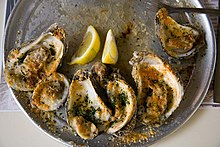
Half dozen chargrilled oysters
Bakery'southward dozen [edit]
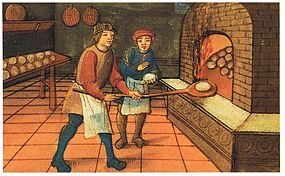
The "baker's dozen" may have originated as a fashion for bakers to avoid existence blamed for shorting their customers.
A baker's dozen, devil'due south dozen,[12] [13] long dozen, or long mensurate is 13, one more than a standard dozen. The broadest apply of baker's dozen today is simply a group of xiii objects (often baked appurtenances).[xiv] The term has meant dissimilar things over the last few centuries.
In the United Kingdom when selling sure goods, bakers were obliged to sell appurtenances by the dozen at a specific weight or quality (or a specific boilerplate weight). During this time, bakers who sold a dozen units that failed to run across this requirement could be penalized with a fine. Therefore, to avert risking this penalty, some bakers included an extra unit to be sure the minimum weight was met, bringing the total to xiii units or what is now commonly known every bit a baker's dozen.[15] [ improve source needed ]
Co-ordinate to the Oxford English Dictionary, the term "baker's dozen" originated in the late 16th century and is "manifestly so chosen afterward the former do amidst bakers of including a thirteenth loaf when selling a dozen to a retailer, the actress loaf representing the retailer's profit."[xvi]
Co-ordinate to the 1811 Classical Dictionary of the Vulgar Tongue, by Francis Grose, "a Baker'southward Dozen is Thirteen; that number of rolls being allowed to the purchaser of a dozen".[17] Nevertheless, opposite to most sources, according to the anonymous 1785 version of that dictionary, which was probably also by Grose, "a Bakery'south Dozen is Fourteen, that number of rolls being allowed to the purchaser of a dozen".[18]
The term has also been defined in a jocular style, equally "twelve of today'south and i of yesterday's."[ commendation needed ]
The 13th loaf added to the dozen is called the vantage loaf.[19]
Texas dozen [edit]
A lesser used term is the Texas Dozen, which generally consists of 15. This is typically used only in Texas and surrounding areas for such goods as flowers or baked goods, although can be practical to annihilation that is counted, such as photographs. [20] It is a play on the expression "Everything is bigger in Texas".
Run into also [edit]
- Lagniappe
- Fourteener (poetry)
- Seed-counting machine
References [edit]
- ^ "A072938 - Oeis".
- ^ Longman Lexicon of Gimmicky English, 2013, Procter, Paul 1408267667
- ^ Bartleby, archived from the original on December 10, 2006
- ^ "Dozen". Free Lexicon. Merriam-Webster. Retrieved 2011-10-28 .
- ^ "dozen". Oxford Dictionaries Online. Inquire Oxford. Archived from the original on September 26, 2007. Retrieved 2013-01-31 .
- ^ "Douzain, Douzaine, Douze, Douze-huit, Douzième, Douzièmement, Dox(o)-, Doxographe, Doxologie, Doyen". Patrimoine de French republic. Archived from the original on 2011-09-29. Retrieved 2011-10-28 .
- ^ "docena". Diccionario Usual (in Spanish). Real Academia Española. Retrieved 2011-ten-28 .
- ^ "doce". Diccionario Usual (in Spanish). Real Academia Española. Retrieved 2011-10-28 .
- ^ "‐ena". Diccionario Usual (in Spanish). Real Academia Española. Retrieved 2011-10-28 .
- ^ "meaning #4", English language Lexicon, Oxford .
- ^ Melville-Lee (1901), A History of Police force in England, Methuen
- ^ "devil's dozen", Merriam-Webster.com Dictionary
- ^ "devil – phrases: the devil'south dozen". Concise Oxford English Dictionary: Luxury Edition. Vol. 12. Oxford University Press. 2011. p. 392. ISBN9780199601110.
- ^ Webster (1999), Webster'southward II New College Lexicon , Houghton Mifflin Company, ISBN0395962145 .
- ^ "The Baker's Dozen", The Baker'due south Helper, vol. 36, Clissold Publishing Company, 1921, p. 562 .
- ^ Stevenson, Angus (2010), Oxford English language Dictionary (tertiary ed.), ISBN9780191727665 .
- ^ Francis Grose (2007) [1811], Classical Lexicon of the vulgar tongue (unabridged ed.), p. 18 .
- ^ Francis Grose (1785) [1785], A Classical Dictionary of the Vulgar natural language, p. 19 .
- ^ Brewer's Lexicon of Phrase and Fable. London: Cassel and Co. 2000. pp. 1227. ISBN0304350966.
- ^ "Texas Monthly". April 1980.
External links [edit]
- History of the term Baker's dozen The Phrase Finder

How Many Is 1 Dozen,
Source: https://en.wikipedia.org/wiki/Dozen
Posted by: calhoonvandice.blogspot.com
0 Response to "How Many Is 1 Dozen"
Post a Comment