

How To Break A Tie Vote
Tie votes in STAR Voting are rare - well over 10 times less common than with cull-i voting- only as with any voting method they can occur, especially in modest demos or elections without many voters.
Standard Tie-breaking Protocol
In well-nigh cases, ties in STAR voting can be cleaved by referring back to the ballots themselves:
Stride ane: Ties in the scoring round should be determined in favor of the candidate who was preferred (scored higher) by more than voters. If there are merely two candidates this volition be the majority preferred candidate, if there are multiple tied candidates this volition be the candidate(s) preferred over all other candidates. (See section below on Condorcet winners and losers.)
Pace 2: Ties in the Runoff Round should exist broken in favor of the candidate who was scored higher if possible.
Stride iii: In the effect that a necktie can not exist resolved as higher up, the ballot will be chosen equally a tie and broken randomly, unless a farther tie breaking procedure was adopted in advance of the election and was publicly disclosed.
Establish tie-breaking protocols in advance of the ballot
The body hosting the election is responsible for establishing tie-breaking protocols in advance of information technology's elections. In the event that no protocol has been specified, and the ballot has already been conducted the standard tie breaking protocol above should be used as the default.
Cardinal considerations for resolving ties:
- Resolve ties every bit described in a higher place in steps ane and ii if possible.
- If there are remaining ties, a coin toss or random tiebreaker is a valid option.
- If desired, you may want to choice an additional tie-breaking protocol that is more than formative.
- Fix boosted protocols in rock before the election!
Additional Tiebreaker Options
- Five Star Tiebreaker:If an additional tie breaking protocol is desired, (beyond steps 1 and 2 above,) break the tie in favor of the tied candidate who received the most five star votes as follows: Determine how many voters gave a five star rating to each of the tied candidates. The candidate who received the about v star ratings wins.
- Random Tiebreaker: If an additional necktie breaking protocol is desired, (across steps 1 and 2 above,) break the tie randomly. Mutual examples of a random tiebreaker include a coin toss, a name describe, or in cases where candidates names appeared on the election in a randomly generated order, electing the candidate whose name appeared first.
What if we want to employ a different tiebreaker protocol that isn't listed in a higher place?
At that place are a number of fair and valid means to break ties. STAR ballots tin can be run with another voting method such as with this Condorcet tiebreaker if desired. (The Five Star Protocol higher up is essentially a Plurality or Approving Voting tiebreaker.) As long as a protocol is fair and is chosen in advance it can be used, however, we recommend against using more complex tiebreakers for the sake of transparency, and because it's unnecessary.
What is a preference matrix?
A preference matrix is a chart which shows all the voter preference data from a given election.
When do I need a matrix and why?
In most elections a full matrix isn't needed. All that is needed to select the winner is to determine the preferences between the two highest scoring candidates.
A preference matrix is a great reference point for looking at the additional information which can be gleaned in STAR elections. It may as well be helpful for breaking ties in the scoring circular.
Another reason a matrix might exist needed is if ballots are not being tallied centrally, or if ballots volition be counted in sets as they come in. Creating a matrix for each sub-set of ballots allows each set to exist fully tallied on it's own and then exist compiled with other sets of ballots later. This is a feature known as summability. Ballot summability ways that with STAR Voting local audits and/or partial recounts are possible if needed. Summability is an important requirement for election security and integrity. STAR Voting and nearly voting methods are summable, but Instant Runoff voting, the type of Ranked Choice widely used around the globe, is not.
Preference matrices provide a lot more information across who won and lost, so they are frequently used in data assay. One advantage of STAR Voting over choose-one is that all of this additional information is available.
How exercise I create a preference matrix?
Unless you are doing a mitt count, a matrix can be generated automatically and will unremarkably be bachelor with your election results, depending on the platform you lot're using.
Creating a preference matrix by manus is merely like tallying a STAR election, simply with an actress runoff for each pair of candidates:
- Full the scores given to each candidate in the election.
- Just like in the STAR runoff, the ii highest scoring candidates are selected. Sort the ballots to notice how many voters preferred each of those finalists. Ballots are sorted into three stacks: Ballots preferring one finalist, ballots preferring the other, and ballots who gave both the aforementioned score and thus have no preference between those two.
- If you are doing a manus count you will likely have establish your winner and can end hither, completing a full preference matrix is completely optional. In the example below Allison won with 35 points. She was preferred past 8 out of 10 voters, or 80%.
- To create a full preference matrix, repeat the step higher up for each pair of candidates, for instance, Allison vs Bill, Allison vs Carmen, and so on. Record the number of ballots which preferred each candidate in each head-to-head match in the respective box.

Tiebreaker Example #1:

In the example to a higher place we have a tie in the scoring round. Nib and Carmen are tied for 2nd highest scoring candidate with 32 stars each so we'll demand to break the necktie to make up one's mind who should accelerate to the runoff. Looking at the preference matrix we tin determine that Nib is preferred over Carmen, (five voters prefer Bill over Carmen, simply but four voters prefer Carmen over Bill,) so this is a elementary necktie that tin can exist easily resolved. Neb advances to the runoff.
In the runoff, nosotros discover that Allison and Bill are both preferred by the aforementioned number of voters, (5 each,) but looking at the scores we discover that Allison was scored higher overall and then this is another simple tie that tin be easily resolved. Allison wins the election.
Tiebreaker Example #ii:
 In the example above, Allison, Bill, Carmen, and Doug are all tied for highest scoring with 78 stars each. Looking at the preference matrix we find that there is a three way tie in the runoff as well! Allison is preferred to Bill, Bill to Carmen, and Carmen to Allison. (This is known as a Condorcet cycle.) Doug is non preferred over any of the others so he is not i of the tied candidates.
Ties like these should be resolved by a necktie-breaker chosen and agreed to in advance such every bit 1 of the options listed above.
What are Condorcet winners and losers and how exercise I place them?
A Condorcet winner is a candidate who in caput-to-head match-ups was preferred over every other candidate. A Condorcet loser is a candidate who was not preferred over whatever of the other candidates.
You can apply a preference matrix to quickly compare any two candidates head-to-head to detect Condorcet winners and losers.
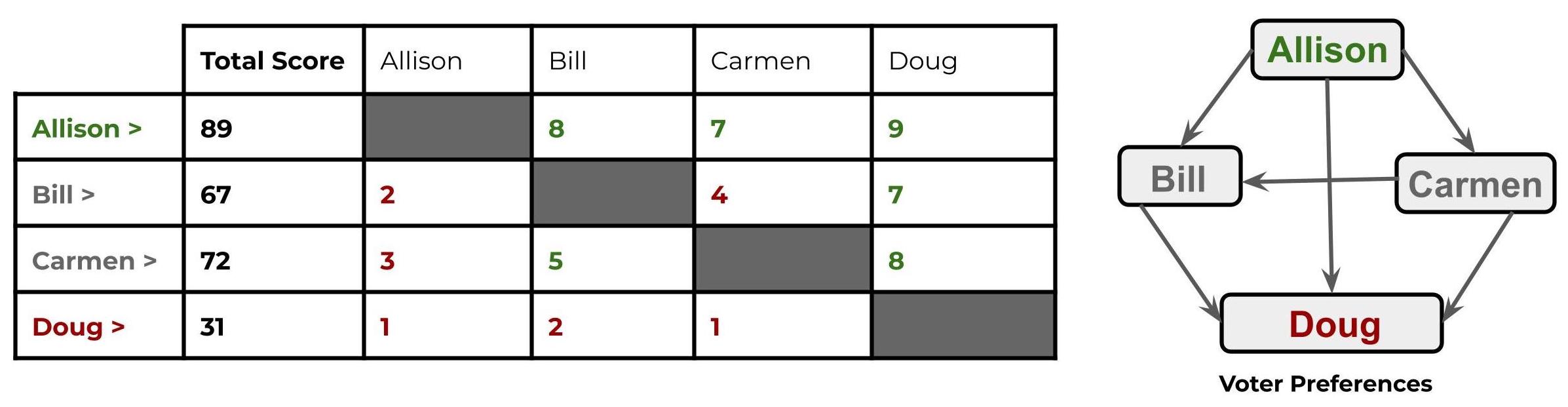
In this ballot Allison is preferred head-to-head over all other candidates, which makes her the Condorcet winner. Doug is non preferred over any of the others, and then he is the Condorcet loser. If Doug was eliminated, then Bill would become the new Condorcet loser.
STAR Voting commonly elects the Condorcet winner if there is i. If STAR elects a different winner, it's because determining Condorcet winners simply takes into account preference lodge just doesn't take into account the strength of support (total score) for the candidates.
STAR Voting finds winners past maximizing both strength of support and number of supporters.
If you are running an election and have additional questions or would similar guidance please email us at [email protected]
Source: https://www.starvoting.org/ties
0 Response to "How To Break A Tie Vote"
Post a Comment