

And The Raven Never Flitting
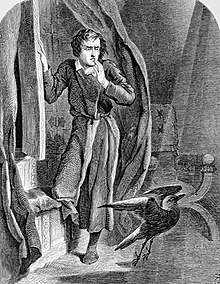
"The Raven" depicts a mysterious raven'due south midnight visit to a mourning narrator, equally illustrated by John Tenniel (1858).

"The Raven" is a narrative verse form by American writer Edgar Allan Poe. First published in Jan 1845, the verse form is oft noted for its musicality, stylized language, and supernatural atmosphere. It tells of a talking raven'south mysterious visit to a distraught lover, tracing the man's irksome descent into madness. The lover, oft identified as a pupil,[1] [2] is lamenting the loss of his love, Lenore. Sitting on a bosom of Pallas, the raven seems to further distress the protagonist with its constant repetition of the word "Nevermore". The poem makes use of folk, mythological, religious, and classical references.
Poe claimed to have written the poem logically and methodically, with the intention to create a verse form that would appeal to both disquisitional and popular tastes, as he explained in his 1846 follow-upwards essay, "The Philosophy of Composition". The poem was inspired in part by a talking raven in the novel Barnaby Rudge: A Tale of the Riots of Eighty past Charles Dickens.[3] Poe based the complex rhythm and meter on Elizabeth Barrett's poem "Lady Geraldine's Courtship", and makes use of internal rhyme besides every bit alliteration throughout.
"The Raven" was first attributed to Poe in print in the New York Evening Mirror on January 29, 1845. Its publication made Poe popular in his lifetime, although it did not bring him much financial success. The verse form was soon reprinted, parodied, and illustrated. Critical opinion is divided equally to the verse form's literary status, only it still remains one of the almost famous poems ever written.[4]
Synopsis [edit]
The Raven[5]
In one case upon a midnight dreary, while I pondered, weak and weary,
Over many a quaint and curious volume of forgotten lore—
While I nodded, nigh napping, of a sudden there came a borer,
As of some ane gently rapping, rapping at my sleeping room door.
"'Tis some visiter," I muttered, "tapping at my bedchamber door—
Only this and nix more."
Ah, distinctly I recollect it was in the dour December;
And each carve up dying ember wrought its ghost upon the floor.
Eagerly I wished the morrow;—vainly I had sought to borrow
From my books surcease of sorrow—sorrow for the lost Lenore—
For the rare and radiant maiden whom the angels proper name Lenore—
Nameless here for evermore.And the silken, sad, uncertain rustling of each purple curtain
Thrilled me—filled me with fantastic terrors never felt earlier;
So that now, to still the beating of my heart, I stood repeating
"'Tis some visiter entreating archway at my chamber door—
Some tardily visiter entreating entrance at my sleeping room door;—
This it is and aught more."Soon my soul grew stronger; hesitating so no longer,
"Sir," said I, "or Madam, truly your forgiveness I implore;
But the fact is I was napping, so gently yous came rapping,
So faintly you lot came tapping, tapping at my chamber door,
That I scarce was sure I heard you"—here I opened wide the door;—
Darkness there and nada more than.Deep into that darkness peering, long I stood in that location wondering, fearing,
Doubting, dreaming dreams no mortal ever dared to dream before;
But the silence was unbroken, and the stillness gave no token,
And the only word there spoken was the whispered word, "Lenore?"
This I whispered, and an echo murmured back the discussion, "Lenore!"—
Simply this and nothing more.Dorsum into the sleeping room turning, all my soul within me burning,
Shortly once more I heard a tapping somewhat louder than before.
"Surely," said I, "surely that is something at my window lattice;
Allow me see, and then, what thereat is, and this mystery explore—
Let my middle exist yet a moment and this mystery explore;—
'Tis the wind and nothing more!"Open hither I flung the shutter, when, with many a flirt and flutter,
In in that location stepped a stately Raven of the saintly days of yore;
Not the least obeisance made he; not a infinitesimal stopped or stayed he;
But, with mien of lord or lady, perched in a higher place my bedchamber door—
Perched upon a bust of Pallas just above my chamber door—
Perched, and sabbatum, and nothing more than.Then this ebony bird beguiling my sad fancy into smiling,
Past the grave and stern decorum of the countenance it wore,
"Though thy crest exist shorn and shaven, k," I said, "art sure no craven,
Ghastly grim and aboriginal Raven wandering from the Nightly shore—
Tell me what thy lordly name is on the Nighttime's Plutonian shore!"
Quoth the Raven "Nevermore."Much I marvelled this ungainly fowl to hear discourse so plainly,
Though its answer niggling meaning—trivial relevancy bore;
For nosotros cannot help agreeing that no living human
Ever nonetheless was blessed with seeing bird to a higher place his sleeping accommodation door—
Bird or beast upon the sculptured bust above his chamber door,
With such name as "Nevermore."But the Raven, sitting lone on the placid bust, spoke only
That i word, equally if his soul in that ane word he did outpour.
Nothing farther then he uttered—not a feather then he fluttered—
Till I scarcely more muttered "Other friends have flown before—
On the morrow he volition get out me, every bit my Hopes have flown before."
Then the bird said "Nevermore."Startled at the stillness cleaved by reply so aptly spoken,
"Doubtless," said I, "what it utters is its only stock and store
Caught from some unhappy chief whom unmerciful Disaster
Followed fast and followed faster till his songs ane brunt bore—
Till the dirges of his Hope that melancholy burden bore
Of 'Never—nevermore'."But the Raven notwithstanding beguiling my sad fancy into smiling,
Straight I wheeled a cushioned seat in front end of bird, and bosom and door;
Then, upon the velvet sinking, I betook myself to linking
Fancy unto fancy, thinking what this ominous bird of yore—
What this grim, ungainly, ghastly, gaunt, and ominous bird of yore
Meant in husky "Nevermore."This I sat engaged in guessing, but no syllable expressing
To the fowl whose fiery eyes now burned into my bosom'southward core;
This and more I sabbatum divining, with my head at ease reclining
On the cushion'southward velvet lining that the lamp-light gloated o'er,
Simply whose velvet-violet lining with the lamp-light gloating o'er,
She shall press, ah, nevermore!Then, methought, the air grew denser, perfumed from an unseen censer
Swung by seraphim whose foot-falls tinkled on the tufted floor.
"Wretch," I cried, "thy God hath lent thee—by these angels he hath sent thee
Respite—respite and nepenthe, from thy memories of Lenore;
Carouse, oh quaff this kind nepenthe and forget this lost Lenore!"
Quoth the Raven "Nevermore.""Prophet!" said I, "thing of evil!—prophet withal, if bird or devil!—
Whether Tempter sent, or whether tempest tossed thee hither ashore,
Desolate yet all undaunted, on this desert land enchanted—
On this home past Horror haunted—tell me truly, I implore—
Is in that location—is there balm in Gilead?—tell me—tell me, I implore!"
Quoth the Raven "Nevermore.""Prophet!" said I, "affair of evil!—prophet withal, if bird or devil!
By that Heaven that bends above us—past that God we both adore—
Tell this soul with sorrow laden if, within the distant Aidenn,
It shall clasp a sainted maiden whom the angels proper noun Lenore—
Squeeze a rare and radiant maiden whom the angels proper name Lenore."
Quoth the Raven "Nevermore.""Be that discussion our sign of parting, bird or fiend!" I shrieked, upstarting—
"Become thee back into the tempest and the Night's Plutonian shore!
Leave no black plume as a token of that lie thy soul hath spoken!
Go out my loneliness unbroken!—quit the bust above my door!
Accept thy nib from out my heart, and accept thy course from off my door!"
Quoth the Raven "Nevermore."And the Raven, never flitting, all the same is sitting, nevertheless is sitting
On the pallid bust of Pallas just in a higher place my bedroom door;
And his eyes accept all the seeming of a demon's that is dreaming,
And the lamp-calorie-free o'er him streaming throws his shadow on the floor;
And my soul from out that shadow that lies floating on the floor
Shall be lifted—nevermore!
—Edgar Allan Poe

"Non the least obeisance made he", as illustrated by Gustave Doré (1884)
"The Raven" follows an unnamed narrator on a dreary night in Dec who sits reading "forgotten lore" by a dying fire[six] as a style to forget the death of his beloved Lenore. A "tapping at [his] sleeping accommodation door"[6] reveals nothing, merely excites his soul to "called-for".[vii] The borer is repeated, slightly louder, and he realizes it is coming from his window. When he goes to investigate, a raven flutters into his sleeping accommodation. Paying no attending to the homo, the raven perches on a bust of Pallas higher up the door.
Tickled by the raven's comically serious disposition, the man asks that the bird tell him its name. The raven's only reply is "Nevermore".[seven] The narrator is surprised that the raven can talk, though at this point information technology has said nothing further. The narrator remarks to himself that his "friend" the raven will shortly fly out of his life, simply as "other friends have flown before"[vii] along with his previous hopes. As if answering, the raven responds once more with "Nevermore".[vii] The narrator reasons that the bird learned the discussion "Nevermore" from some "unhappy chief" and that it is the only give-and-take it knows.[seven]
Even so, the narrator pulls his chair direct in front end of the raven, determined to learn more than about it. He thinks for a moment in silence, and his mind wanders dorsum to his lost Lenore. He thinks the air grows denser and feels the presence of angels, and wonders if God is sending him a sign that he is to forget Lenore. The bird over again replies in the negative, suggesting that he can never be free of his memories. The narrator becomes aroused, calling the raven a "matter of evil" and a "prophet".[8] Finally, he asks the raven whether he volition exist reunited with Lenore in Heaven. When the raven responds with its typical "Nevermore", he is enraged, and, calling the bird a liar, commands it to return to the "Plutonian shore"[8]—merely information technology does not move. At the time of the poem'due south narration, the raven "still is sitting"[8] on the bust of Pallas. The raven casts a shadow on the sleeping room flooring and the despondent narrator laments that out of this shadow his soul shall be "lifted 'nevermore'".[8]
Assay [edit]
Poe wrote the poem every bit a narrative, without intentional allegory or didacticism.[2] The main theme of the poem is one of undying devotion.[9] The narrator experiences a perverse disharmonize between desire to forget and want to call up. He seems to get some pleasure from focusing on loss.[10] The narrator assumes that the give-and-take "Nevermore" is the raven'south "only stock and store", and, withal, he continues to inquire it questions, knowing what the reply will be. His questions, then, are purposely self-deprecating and farther incite his feelings of loss.[11] Poe leaves information technology unclear whether the raven actually knows what it is saying or whether it actually intends to cause a reaction in the poem's narrator.[12] The narrator begins as "weak and weary", becomes regretful and grief-stricken, before passing into a frenzy and, finally, madness.[13] Christopher F. Due south. Maligec suggests the poem is a type of elegiac paraclausithyron, an ancient Greek and Roman poetic form consisting of the lament of an excluded, locked-out lover at the sealed door of his beloved.[14]
Allusions [edit]

Poe says that the narrator is a immature scholar.[fifteen] Though this is non explicitly stated in the poem, it is mentioned in "The Philosophy of Composition". Information technology is as well suggested by the narrator reading books of "lore" equally well equally by the bust of Pallas Athena, Greek goddess of wisdom.[1]
He is reading in the late night hours from "many a quaint and curious volume of forgotten lore".[six] Similar to the studies suggested in Poe's short story "Ligeia", this lore may be almost the occult or black magic. This is too emphasized in the writer'due south choice to set up the poem in Dec, a month which is traditionally associated with the forces of darkness. The use of the raven—the "devil bird"—also suggests this.[sixteen] This devil image is emphasized past the narrator'due south belief that the raven is "from the Night'south Plutonian shore", or a messenger from the afterlife, referring to Pluto, the Roman god of the underworld[10] (too known as Dis Pater in Roman mythology). A straight allusion to Satan also appears: "Whether Tempter sent, or whether tempest tossed thee here ashore..."
Poe chose a raven as the central symbol in the story considering he wanted a "non-reasoning" creature capable of voice communication. He decided on a raven, which he considered "every bit capable of speech" as a parrot, because it matched the intended tone of the poem.[17] Poe said the raven is meant to symbolize "Mournful and Never-catastrophe Remembrance".[eighteen] He was also inspired by Grip, the raven in Barnaby Rudge: A Tale of the Riots of Lxxx by Charles Dickens.[19] 1 scene in particular bears a resemblance to "The Raven": at the terminate of the 5th affiliate of Dickens's novel, Grip makes a noise and someone says, "What was that—him tapping at the door?" The response is, "'Tis someone knocking softly at the shutter."[20] Dickens's raven could speak many words and had many comic turns, including the popping of a champagne cork, but Poe emphasized the bird's more dramatic qualities. Poe had written a review of Barnaby Rudge for Graham'southward Magazine maxim, among other things, that the raven should have served a more symbolic, prophetic purpose.[20] The similarity did non go unnoticed: James Russell Lowell in his A Fable for Critics wrote the verse, "Here comes Poe with his raven, like Barnaby Rudge / Three-fifths of him genius and two-fifths sheer fudge."[21] The Free Library of Philadelphia has on display a taxidermied raven that is reputed to be the very one that Dickens owned and that helped inspire Poe's poem.[22]
Poe may besides have been drawing upon various references to ravens in mythology and folklore. In Norse mythology, Odin possessed two ravens named Huginn and Muninn, representing thought and memory.[23] Co-ordinate to Hebrew folklore, Noah sends a white raven to check conditions while on the ark.[17] It learns that the floodwaters are showtime to dissipate, simply it does non immediately render with the news. It is punished by being turned black and being forced to feed on carrion forever.[23] In Ovid's Metamorphoses, a raven also begins as white before Apollo punishes it by turning it blackness for delivering a bulletin of a lover's unfaithfulness. The raven'southward role as a messenger in Poe's verse form may draw from those stories.[23]
Nepenthe, a drug mentioned in Homer'due south Odyssey, erases memories; the narrator wonders aloud whether he could receive "respite" this manner: "Quaff, oh carouse this kind nepenthe and forget this lost Lenore!"
Poe also mentions the Lotion of Gilead, a reference to the Book of Jeremiah (eight:22) in the Bible: "Is in that location no balm in Gilead; is there no md at that place? why so is not the health of the daughter of my people recovered?"[24] In that context, the Lotion of Gilead is a resin used for medicinal purposes (suggesting, perhaps, that the narrator needs to be healed afterwards the loss of Lenore). In 1 Kings 17:1 – 5 Elijah is said to exist from Gilead, and to have been fed past ravens during a catamenia of drought.[25]
Poe also refers to "Aidenn", another give-and-take for the Garden of Eden, though the narrator uses it to ask if he shall reunite with his Lenore in Heaven.
Poetic structure [edit]
The poem is made up of 18 stanzas of six lines each. Generally, the meter is trochaic octameter—8 trochaic anxiety per line, each human foot having i stressed syllable followed by one unstressed syllable.[three] The commencement line, for example (with / representing stressed syllables and 10 representing unstressed):
| Stress | / | x | / | x | / | x | / | 10 | / | 10 | / | 10 | / | x | / | 10 |
|---|---|---|---|---|---|---|---|---|---|---|---|---|---|---|---|---|
| Syllable | Once | up- | on | a | mid- | night | drea- | ry, | while | I | pon- | dered | weak | and | wea- | ry |
Poe, however, claimed the verse form was a combination of octameter acatalectic, heptameter catalectic, and tetrameter catalectic.[15] The rhyme scheme is ABCBBB, or AA,B,CC,CB,B,B when accounting for internal rhyme. In every stanza, the "B" lines rhyme with the discussion "nevermore" and are catalectic, placing actress emphasis on the last syllable. The verse form also makes heavy apply of alliteration ("Doubting, dreaming dreams ...").[26] 20th-century American poet Daniel Hoffman suggested that the verse form'due south structure and meter is so formulaic that it is bogus, though its mesmeric quality overrides that.[27]
Poe based the structure of "The Raven" on the complicated rhyme and rhythm of Elizabeth Barrett'due south poem "Lady Geraldine'due south Courtship".[fifteen] Poe had reviewed Barrett'southward work in the January 1845 issue of the Broadway Periodical [28] and said that "her poetic inspiration is the highest—nosotros can conceive of nothing more august. Her sense of Fine art is pure in itself."[29] As is typical with Poe, his review too criticizes her lack of originality and what he considers the repetitive nature of some of her verse.[30] Nearly "Lady Geraldine's Courtship", he said "I accept never read a poem combining so much of the fiercest passion with so much of the about delicate imagination."[29]
Publication history [edit]

Poe starting time brought "The Raven" to his friend and former employer George Rex Graham of Graham's Magazine in Philadelphia. Graham declined the verse form, which may non have been in its concluding version, though he gave Poe $15 as charity.[31] Poe then sold the poem to The American Review, which paid him $9 for it,[32] and printed "The Raven" in its February 1845 issue under the pseudonym "Quarles", a reference to the English poet Francis Quarles.[33] The poem'due south beginning publication with Poe's name was in the Evening Mirror on Jan 29, 1845, as an "advance re-create".[15] Nathaniel Parker Willis, editor of the Mirror, introduced it as "unsurpassed in English language poesy for subtle conception, masterly ingenuity of versification, and consistent, sustaining of imaginative lift ... It will stick to the retentiveness of everybody who reads it."[iv] Following this publication the poem appeared in periodicals across the United States, including the New York Tribune (February iv, 1845), Broadway Periodical (vol. i, February viii, 1845), Southern Literary Messenger (vol. 11, March 1845), Literary Emporium (vol. ii, December 1845), Saturday Courier, 16 (July 25, 1846), and the Richmond Examiner (September 25, 1849).[34] It has too appeared in numerous anthologies, starting with Poets and Poetry of America edited by Rufus Wilmot Griswold in 1847.
The firsthand success of "The Raven" prompted Wiley and Putnam to publish a collection of Poe's prose called Tales in June 1845; it was his first book in five years.[35] They also published a collection of his poetry chosen The Raven and Other Poems on November 19 past Wiley and Putnam which included a dedication to Barrett as "the Noblest of her Sexual activity".[36] The small volume, his first book of poetry in xiv years,[37] was 100 pages and sold for 31 cents.[38] In addition to the title poem, it included "The Valley of Unrest", "Bridal Ballad", "The City in the Bounding main", "Eulalie", "The Conqueror Worm", "The Haunted Palace" and eleven others.[39] In the preface, Poe referred to them as "trifles" which had been altered without his permission every bit they made "the rounds of the press".[36]
Illustrators [edit]

An illustration by Édouard Manet, from Mallarmé'south translation, depicting the first two lines of the poem.
Afterward publications of "The Raven" included artwork by well-known illustrators. Notably, in 1858 "The Raven" appeared in a British Poe anthology with illustrations past John Tenniel, the Alice in Wonderland illustrator (The Poetical Works of Edgar Allan Poe: With Original Memoir, London: Sampson Low). "The Raven" was published independently with lavish woodcuts by Gustave Doré in 1884 (New York: Harper & Brothers). Doré died before its publication.[twoscore] In 1875, a French edition with English language and French text, Le Corbeau, was published with lithographs by Édouard Manet and translation by the Symbolist Stéphane Mallarmé.[41] Many 20th-century artists and gimmicky illustrators created artworks and illustrations based on "The Raven", including Edmund Dulac, István Orosz,[42] [43] and Ryan Price.[44]
Composition [edit]
Poe capitalized on the success of "The Raven" past following information technology upward with his essay "The Philosophy of Limerick" (1846), in which he detailed the poem's creation. His description of its writing is probably exaggerated, though the essay serves equally an important overview of Poe'due south literary theory.[45] He explains that every component of the poem is based on logic: the raven enters the chamber to avoid a storm (the "midnight dreary" in the "bleak December"), and its perch on a pallid white bust was to create visual contrast against the dark blackness bird. No aspect of the verse form was an accident, he claims, only is based on total control past the writer.[46] Even the term "Nevermore", he says, is used because of the effect created by the long vowel sounds (though Poe may have been inspired to utilize the discussion past the works of Lord Byron or Henry Wadsworth Longfellow).[47] Poe had experimented with the long o audio throughout many other poems: "no more" in "Silence", "evermore" in "The Conqueror Worm".[1] The topic itself, Poe says, was chosen because "the decease... of a beautiful adult female is unquestionably the most poetical topic in the globe." Told from "the lips ... of a bereaved lover" is best suited to achieve the desired consequence.[ii] Beyond the poetics of it, the lost Lenore may have been inspired past events in Poe'southward ain life as well, either to the early loss of his mother, Eliza Poe, or the long illness endured by his wife, Virginia.[x] Ultimately, Poe considered "The Raven" an experiment to "adapt at once the popular and critical gustation", accessible to both the mainstream and high literary worlds.[ii] It is unknown how long Poe worked on "The Raven"; speculation ranges from a single day to 10 years. Poe recited a poem believed to exist an early on version with an alternate catastrophe of "The Raven" in 1843 in Saratoga, New York.[3] An early draft may have featured an owl.[48]
In the summer of 1844, when the poem was probable written, Poe, his wife, and mother in law were boarding at the farmhouse of Patrick Brennan. The location of the firm, which was demolished in 1888,[49] [50] has been a disputed point and, while at that place are two different plaques marking its supposed location on West 84th Street, it almost probable stood where 206 West 84th Street is now.[fifty] [51] [52]
Critical reception [edit]

Gustave Doré'due south illustration of the final lines of the poem accompanies the phrase "And my soul from out that shadow that lies floating on the flooring/Shall exist lifted—nevermore!"
In part due to its dual printing, "The Raven" fabricated Edgar Allan Poe a household name almost immediately,[53] and turned Poe into a national celebrity.[54] Readers began to identify verse form with poet, earning Poe the nickname "The Raven".[55] The poem was soon widely reprinted, imitated, and parodied.[53] Though information technology made Poe pop in his solar day, it did non bring him significant financial success.[56] As he afterward lamented, "I have made no money. I am as poor now as ever I was in my life—except in hope, which is past no means bankable".[37]
The New World said, "Everyone reads the Poem and praises it ... justly, we think, for it seems to us full of originality and power."[4] The Pennsylvania Inquirer reprinted it with the heading "A Beautiful Poem".[four] Elizabeth Barrett wrote to Poe, "Your 'Raven' has produced a sensation, a fit o' horror, hither in England. Some of my friends are taken by the fearfulness of it and some by the music. I hear of persons haunted past 'Nevermore'."[57] Poe's popularity resulted in invitations to recite "The Raven" and to lecture—in public and at private social gatherings. At i literary salon, a guest noted, "to hear [Poe] repeat the Raven ... is an effect in one'due south life."[58] Information technology was recalled by someone who experienced it, "He would turn downwards the lamps till the room was almost dark, and then continuing in the center of the apartment he would recite ... in the most melodious of voices ... So marvelous was his power as a reader that the auditors would exist agape to describe breath lest the enchanted spell be broken."[59]
Parodies sprung upwardly peculiarly in Boston, New York, and Philadelphia and included "The Craven" by "Poh!", "The Gazelle", "The Whippoorwill", and "The Turkey".[55] I parody, "The Pole-Cat", caught the attention of Andrew Johnston, a lawyer who sent it on to Abraham Lincoln. Though Lincoln admitted he had "several hearty laughs", he had not, at that point read "The Raven".[60] Notwithstanding, Lincoln eventually read and memorized the poem.[61]
"The Raven" was praised past fellow writers William Gilmore Simms and Margaret Fuller,[62] though it was denounced by William Butler Yeats, who chosen it "insincere and vulgar ... its execution a rhythmical trick".[ii] Transcendentalist Ralph Waldo Emerson said, "I see nothing in information technology."[63] A critic for the Southern Quarterly Review wrote in July 1848 that the poem was ruined by "a wild and unbridled extravagance" and that minor things like a tapping at the door and a fluttering pall would only bear upon "a child who had been frightened to the verge of idiocy by terrible ghost stories".[64] An anonymous writer going past the pseudonym "Outis" suggested in the Evening Mirror that "The Raven" was plagiarized from a poem chosen "The Bird of the Dream" by an unnamed author. The writer showed 18 similarities between the poems and was made every bit a response to Poe'southward accusations of plagiarism against Henry Wadsworth Longfellow. It has been suggested Outis was really Cornelius Conway Felton, if not Poe himself.[65] After Poe's expiry, his friend Thomas Holley Chivers said "The Raven" was plagiarized from one of his poems.[66] In particular, he claimed to have been the inspiration for the meter of the verse form too as the refrain "nevermore".[67]
"The Raven" became i of the most popular targets for literary translators in Hungary; more than than a dozen poets rendered it into Hungarian, including Mihály Babits, Dezső Kosztolányi, Árpád Tóth,[68] and György Faludy.[69] Balázs Birtalan wrote its paraphrasis from the raven'southward point of view,[70] with the motto Audiatur et altera pars ("let the other side be heard as well").
Legacy [edit]
"The Raven" has influenced many modernistic works, including Vladimir Nabokov'due south Lolita in 1955, Bernard Malamud'southward "The Jewbird" in 1963 and Ray Bradbury'southward "The Parrot Who Met Papa" in 1976.[71] The process past which Poe composed "The Raven" influenced a number of French authors and composers, such as Charles Baudelaire and Maurice Ravel, and it has been suggested that Ravel'due south Boléro may have been securely influenced by "The Philosophy of Composition".[72] The poem is additionally referenced throughout popular culture in films, boob tube, music, and video games.
The painter Paul Gauguin painted a nude portrait of his teenage wife in Tahiti in 1897 titled Nevermore, featuring a raven perched within the room. At the time the couple were mourning the loss of their showtime child together and Gauguin the loss of his favourite girl dorsum in Europe.
The name of the Baltimore Ravens, a professional American football team, was inspired by the verse form.[73] [74] [75] Chosen in a fan contest that drew 33,288 voters, the allusion honors Poe, who spent the early on part of his career in Baltimore and is cached there.[76]
The mantel of the room in which Poe penned "The Raven" was removed and donated to Columbia Academy before the sabotage of the Brennan Farmhouse. Information technology currently resides at the Rare Book & Manuscript Library, on the 6th floor of Butler Library.[77]
Run into also [edit]
- Allusions to Poe'south "The Raven"
- Cultural depictions of ravens
- "Lenore", an earlier verse form by Poe
Notes [edit]
- ^ a b c Meyers, 163
- ^ a b c d e Silverman, 239
- ^ a b c Kopley & Hayes, 192
- ^ a b c d Silverman, 237
- ^ "Edgar Allan Poe Society of Baltimore – Works – Poems – The Raven". Edgar Allan Poe Society of Baltimore. December 28, 2007.
- ^ a b c d Poe, 773
- ^ a b c d e Poe, 774
- ^ a b c d Poe, 775
- ^ Cornelius, Kay. "Biography of Edgar Allan Poe" in Bloom's BioCritiques: Edgar Allan Poe, Harold Blossom, ed. Philadelphia: Chelsea House Publishers, 2002. p. 21 ISBN 0-7910-6173-6
- ^ a b c Kopley & Hayes, 194
- ^ Hoffman, 74
- ^ Hirsch, 195-6
- ^ Hoffman, 73–74
- ^ Maligec, Christopher F. Southward. (2009). "'The Raven' as an Elegiac Paraclausithyron". Poe Studies. 42: 87–97. doi:10.1111/j.1947-4697.2009.00015.ten. S2CID 163043175.
- ^ a b c d Sova, 208
- ^ Granger, 53–54
- ^ a b Hirsch, 195
- ^ Silverman, 240
- ^ Meyers, 162
- ^ a b "Cremains / Ravens". palimpsest.stanford.edu. Archived from the original on February 23, 2008. Retrieved April 1, 2007.
- ^ Cornelius, Kay. "Biography of Edgar Allan Poe" in Bloom's BioCritiques: Edgar Allan Poe, Harold Bloom, ed. Philadelphia: Chelsea House Publishers, 2002. p. 20 ISBN 0-7910-6173-half dozen
- ^ "Poe's Raven Stuffed at Costless Library". Philadelphia Magazine. October 31, 2011. Retrieved January 30, 2014.
- ^ a b c Adams, 53
- ^ Jeremiah 8:22
- ^ 1 Kings 17:1 – 5
- ^ Kopley & Hayes, 192–193
- ^ Hoffman, 76
- ^ Thomas & Jackson, 485
- ^ a b Meyers, 160
- ^ Peeples, 142
- ^ Hoffman, 79
- ^ Ostrom, v
- ^ Silverman, 530
- ^ "The Poems of Edgar Allan Poe". Edgar Allan Poe Society of Baltimore. Apr 27, 2007. Retrieved September 20, 2007.
- ^ Meyers, 177
- ^ a b Thomas & Jackson, 591
- ^ a b Peeples, 136
- ^ Silverman, 299
- ^ Sova, 209
- ^ Scholnick, Robert J. "In Defence force of Beauty: Stedman and the Recognition of Poe in America, 1880–1910", collected in Poe and His Times: The Artist and His Milieu, edited past Benjamin Franklin Fisher 4. Baltimore: The Edgar Allan Poe Society, 1990. p. 262. ISBN 0-9616449-2-3
- ^ "Digital Gallery for Édouard Manet illustrations – Le corbeau". New York Public Library Digital Gallery. Retrieved September 20, 2007.
- ^ Orosz, István. "The poet in the mirror". Gallery Diabolus. Archived from the original on September 27, 2007. Retrieved September xx, 2007. —Anamorphic illustration for "The Raven"
- ^ Orosz, István. "The poet in the mirror". Gallery Diabolus. Archived from the original on September 27, 2007. Retrieved September 20, 2007. —the same illustration with a chrome-plated brass cylinder
- ^ Price, Ryan. "Illustrations past Ryan Price". Ingram Gallery. Archived from the original on September 28, 2007. Retrieved September twenty, 2007.
- ^ Krutch, 98
- ^ Silverman, 295–296
- ^ Forsythe, 439–452
- ^ Weiss, 185
- ^ Hemstreet, William (December 21, 1907). ""Raven" Mantel is in Brooklyn". The New York Times. New York. Retrieved June 15, 2017.
- ^ a b Wolfe, Theodore F. (January 4, 1908). "Poe'south Life at the Brennan House". The New York Times. New York. Retrieved June 15, 2017.
- ^ "Edgar Allan Poe Street". Manhattan Past . Retrieved June 15, 2017.
- ^ White, Norval; Willensky, Elliot; Leadon, Fran (2010). AIA Guide to New York City. Oxford University Press. p. 383. ISBN978-0195383867.
- ^ a b Hoffman, 80
- ^ Peeples, 133
- ^ a b Silverman, 238
- ^ Krutch, 155
- ^ Krutch, 153
- ^ Silverman, 279
- ^ Krutch, 154
- ^ Thomas & Jackson, 635
- ^ Basler, Roy P. and Carl Sandberg. Abraham Lincoln: his speeches and writings. New York: Da Capo Printing, 2001: 185. ISBN 0-306-81075-1.
- ^ Meyers, 184
- ^ Silverman, 265
- ^ Thomas & Jackson, 739
- ^ Moss, 169
- ^ Moss, 101
- ^ Parks, Edd Winfield (1962). Ante-Bellum Southern Literary Critics. Athens, GA: University of Georgia Printing. p. 182.
- ^ Selected Works of Due east. A. Poe in the Hungarian Electronic Library
- ^ Exam és lélek 'Body and Soul', literary translations by György Faludy at the website of Petőfi Literary Museum
- ^ A költő ('The Poet')
- ^ Kopley & Hayes, 196
- ^ Lanford, 243–265.
- ^ "Naming the Team". Baltimore Ravens . Retrieved Oct 17, 2022.
- ^ "Naming Baltimore'due south Team: Ravens". Baltimore Ravens. Archived from the original on July eight, 2016. Retrieved June 22, 2016.
- ^ "Franchise nicknames". Pro Football game Hall of Fame. August nineteen, 2015. Retrieved August 19, 2015.
- ^ "Baltimore Ravens History". Pro Football Hall of Fame. Archived from the original on September viii, 2006. Retrieved August 25, 2006.
- ^ Waldman, Benjamin; Newman, Andy (August 10, 2012). "After a Role in Poe's 'Raven,' the Grit of Obscurity". City Room . Retrieved June 12, 2021.
References [edit]
- Adams, John F. "Classical Raven Lore and Poe's Raven" in Poe Studies. Vol. V, no. 2, December 1972. Available online
- Forsythe, Robert. "Poe'southward 'Nevermore': A Notation", every bit nerveless in American Literature vii. Jan 1936.
- Granger, Byrd Howell. "Marginalia – Devil Lore in 'The Raven'" from Poe Studies vol. V, no. 2, December 1972 Available online
- Hirsch, David H. "The Raven and the Nightingale" every bit nerveless in Poe and His Times: The Artist and His Milieu, edited by Benjamin Franklin Fisher Four. Baltimore: The Edgar Allan Poe Social club, Inc., 1990. ISBN 0-9616449-2-3
- Hoffman, Daniel. Poe Poe Poe Poe Poe Poe Poe. Billy Rouge: Louisiana State University Press, 1972. ISBN 0-8071-2321-8
- Kopley, Richard and Kevin J. Hayes. "Ii verse masterworks: 'The Raven' and 'Ulalume'", collected in The Cambridge Companion to Edgar Allan Poe, edited past Kevin J. Hayes. New York: Cambridge University Printing, 2002. ISBN 0-521-79727-six
- Krutch, Joseph Wood. Edgar Allan Poe: A Study in Genius. New York: Alfred A. Knopf, 1926.
- Lanford, Michael (2011). "Ravel and 'The Raven': The Realisation of an Inherited Aesthetic in Boléro." Cambridge Quarterly forty(3), 243–265.
- Meyers, Jeffrey. Edgar Allan Poe: His Life and Legacy. New York Metropolis: Cooper Square Press, 1992. ISBN 0-8154-1038-seven
- Moss, Sidney P. Poe's Literary Battles: The Critic in the Context of His Literary Milieu. Southern Illinois University Printing, 1969.
- Ostrom, John Ward. "Edgar A. Poe: His Income as Literary Entrepreneur", collected in Poe Studies Vol. five, no. i. June 1982.
- Peeples, Scott. Edgar Allan Poe Revisited. New York: Twayne Publishers, 1998. ISBN 0-8057-4572-6
- Poe, Edgar Allan. Edgar Allan Poe: Complete Tales & Poems. Edison, NJ: Castle Books, 2002. ISBN 0-7858-1453-i
- Silverman, Kenneth. Edgar A. Poe: Mournful and Never-ending Remembrance. New York: Harper Perennial, 1991. ISBN 0-06-092331-eight
- Sova, Dawn B. Edgar Allan Poe: A to Z. New York City: Checkmark Books, 2001. ISBN 0-8160-4161-X
- Thomas, Dwight and David K. Jackson. The Poe Log: A Documentary Life of Edgar Allan Poe, 1809–1849. New York: M. Thousand. Hall & Co., 1987. ISBN 0-7838-1401-1
- Weiss, Susan Archer. The Home Life of Poe. New York: Broadway Publishing Company, 1907.
External links [edit]

- Edgar Allan Poe at Curlie
- The Raven illustrated by Gustave Doré. From the Collections at the Library of Congress
- Le Corbeau = The Raven: Poëme avec illustrations par Édouard Manet. From the Collections at the Library of Congress
- Quaint and Curious—A collection of 19th century parodies and pastiches of "The Raven"
Text [edit]
- "The Raven"—Full text of the starting time printing, from the American Review, 1845
- Page scans at the Internet Archive
- "The Raven"—Full text of the terminal authorized press, from the Richmond Semi-Weekly Examiner, 1849
- "Le Corbeau"—The French Translation of "The Raven" past Stéphane Mallarmé
- "Le Corbeau"—The French Translation of "The Raven" by Charles Baudelaire
- "Bela"—The Basque Translation by Jon Mirande, 1950.
- "Ha-orev"—Hebrew translation by Vladimir Jabotinsky, 1914.
- "Der Raab"—Yiddish translation by Vladimir Jabotinsky.
- "Voron"—Russian translation past Avdotij Vyvihov.
[edit]
- The Poe Decoder—Essay on the symbols, words and composition of "The Raven"
- The Raven. With Literary and Historical Commentary by John H. Ingram. London One thousand. Redway. 1885.
Illustrated [edit]
- Illustrations from The Raven, Gustave Doré illustrations from the University at Buffalo Libraries' Rare & Special Books collection
- The Raven illustrated by Édouard Manet at Project Gutenberg
- The Raven illustrated past Gustave Doré at Project Gutenberg
Audio [edit]
- Reading of 'The Raven' and text by Classic Poesy Aloud (MP3)
- Readings of 'The Raven' in different languages, at Cyberspace Archive
-
 The Raven public domain audiobook at LibriVox

And The Raven Never Flitting,
Source: https://en.wikipedia.org/wiki/The_Raven
Posted by: calhoonvandice.blogspot.com
0 Response to "And The Raven Never Flitting"
Post a Comment